
A Sinagoga Touro
“A Sinagoga Touro não só é a mais antiga sinagoga da América, mas também um dos seus mais antigos símbolos de liberdade. Não há melhor tradição do que a história das contribuições da Sinagoga Touro para os objectivos de liberdade e justiça para todos.”
John F. Kennedy, Presidente dos Estados Unidos,
15 de Setembro de 1963
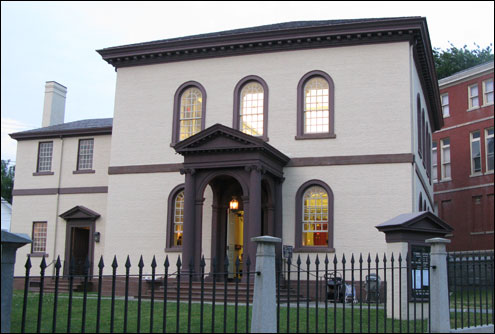
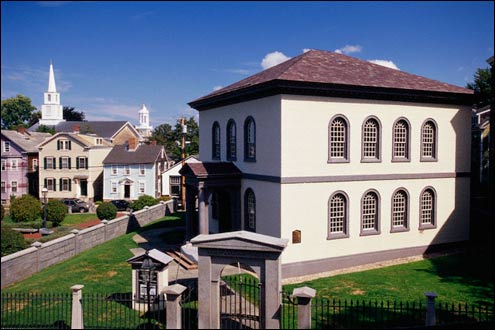
Ostentando o nome de uma família judaica luso-americana com raízes em Tomar, a Sinagoga Touro, de Newport, Rhode Island, foi dedicada a 7 de Dezembro de 1763, no primeiro dia de Hanuká, e permanece hoje como a mais antiga sinagoga dos Estados Unidos — a única do período colonial que ainda sobrevive e se mantém em actividade. A congregação foi fundada em 1658 (apenas 4 anos após a chegada dos primeiros judeus portugueses a Nova Iorque) por judeus sefarditas, na sua maioria marranos e descendentes de marranos que inicialmente tinham fugido da Inquisição portuguesa e que escapavam agora de perseguições sofridas nas Caraíbas às mãos dos espanhóis. Entre os fundadores da comunidade contavam-se Mordecai Campanal, Moisés Israel Pacheco, Simão Mendes e Abraão Burgos. O líder religioso chamava-se Isaac Touro — e um dos seus filhos, Judah Touro ficaria para a história como um dos maiores beneméritos norte-americanos do século XIX. Mas sobre ele prometo escrever outro dia.
Inicialmente impossibilitados de construir uma sinagoga própria, a comunidade de judeus portugueses de Newport reunia-se em casas particulares nas noites de sexta-feira e nas manhãs de sábado.
Durante o seu primeiro século de permanência em Rhode Island (a primeira colónia das 13 colónias originais americanas a declarar independência da Grã-Bretanha), os judeus portugueses prosperaram, tornando-se artesão e mercadores respeitados na colónia esmagadoramente protestante. O seu sucesso atraiu um influxo migratória de judeus sefarditas e asquenazim (judeus da Europa Oriental, com raiz na palavra hebraica Asquenaz, que significa Alemanha), que se juntaram à comunidade inicial, adoptando em conjunto os rituais religiosos tradicionais dos judeus de Portugal e Espanha. Com o crescimento da comunidade veio a necessidade de encontrar um local permanente para a realização dos serviços religiosos, e para isso voltaram-se para outras comunidades de judeus portugueses. A primeira resposta veio da congregação Shearith Israel, de Nova Iorque, a mais antiga do país, que enviou uma generosa contribuição de £149.060. Outras congregações de judeus portugueses — nomeadamente da Jamaica, Curaçao, Suriname e Londres — contribuíram também com ajuda financeira para a construção da sinagoga.
Peter Harrison, o mais famoso arquitecto americano do século XVIII, ofereceu-se para fazer o projecto do edifício, que demorou quatro anos a construir, sendo dedicado a 2 de Dezembro de 1763 pelo rabino da congregação, o luso-americano Isaac Touro.
A cerimónia de dedicação do edifício contou com a presença de muitos notáveis entre a elite protestante de Newport. A sinagoga Touro é considerada uma das mais emblemáticas obras de Peter Harrison, entre as quais se incluem a Kings Chapel, de Boston, e a Igreja de Cristo, em Cambridge, ambas no estado de Massachussetts.
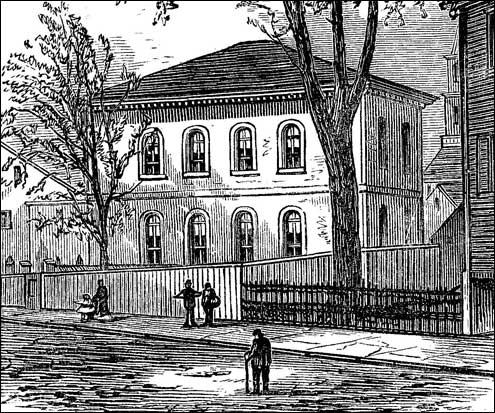
Com a sinagoga, e um cemitério adquirido anos antes, a congregação portuguesa podia agora cumprir três das funções essenciais da vida comunitária judaica — os rituais religiosos propriamente ditos, a educação das crianças e os funerais. A congregação de judeus portugueses de Newport escolheu para si o nome de Yeshuat Israel (Salvação de Israel).
Durante a Guerra de Independência dos Estados Unidos, e por causa do bloqueio britânico ao porto da cidade, grande parte da comunidade escapou para Nova Iorque. Findo o conflito, a vitalidade da congregação reacendeu-se. Pelo facto de durante a guerra muitos dos edifícios públicos da cidade terem ficado danificados, a Sinagoga Touro foi utilizada também para reuniões da Assembleia Geral de Rhode Island e do Supremo Tribunal estadual.
Em 1790, a convite do rabino Moisés Seixas, o Presidente George Washington visita esta sinagoga de judeus portugueses e dias depois lhes envia uma carta que ficaria para a história, reafirmando os princípios de igualdade e tolerância religiosa que norteavam a Constituição americana: “(…) Porque felizmente, o governo dos Estados Unidos, que não confere sanção à intolerância, nem à perseguição assistência (…)”. Estas palavras eram escritas um ano antes da Declaração de Direitos, que mesmo assim apenas se aplicava ao governo federal.
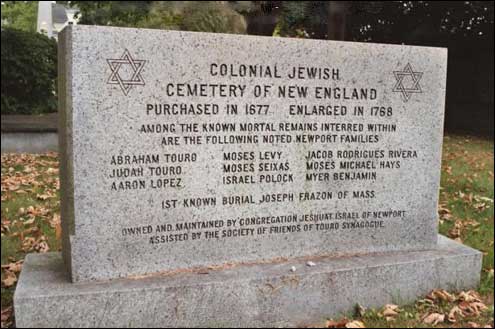
A par da Sinagoga Touro, o cemitério da congregação de judeus sefarditas de Newport é outro testemunho da dimensão e peso da comunidade de Newport. No Verão de 1852, o poeta Henry Wadsworth Longfellow ficou tão impressionado com o cemitério sefardita que o imortalizou num dos seus mais reconhecidos poemas, publicado na Putnam’s Monthly Magazine, em Julho de 1854:
The Jewish Cemetery at Newport
How strange it seems! These Hebrews in their graves,
Close by the street of this fair seaport town,
Silent beside the never-silent waves,
At rest in all this moving up and down!
The trees are white with dust, that o’er their sleep
Wave their broad curtains in the south-wind’s breath,
While underneath these leafy tents they keep
The long, mysterious Exodus of Death.
And these sepulchral stones, so old and brown,
That pave with level flags their burial-place,
Seem like the tablets of the Law, thrown down
And broken by Moses at the mountain’s base.
The very names recorded here are strange,
Of foreign accent, and of different climes;
Alvares and Rivera interchange
With Abraham and Jacob of old times.
“Blessed be God! for he created Death!”
The mourners said, “and Death is rest and peace;”
Then added, in the certainty of faith,
“And giveth Life that nevermore shall cease.”
Closed are the portals of their Synagogue,
No Psalms of David now the silence break,
No Rabbi reads the ancient Decalogue
In the grand dialect the Prophets spake.
Gone are the living, but the dead remain,
And not neglected; for a hand unseen,
Scattering its bounty, like a summer rain,
Still keeps their graves and their remembrance green.
How came they here? What burst of Christian hate,
What persecution, merciless and blind,
Drove o’er the sea — that desert desolate–
These Ishmaels and Hagars of mankind?
They lived in narrow streets and lanes obscure,
Ghetto and Judenstrass, in mirk and mire;
Taught in the school of patience to endure
The life of anguish and the death of fire.
All their lives long, with the unleavened bread
And bitter herbs of exile and its fears,
The wasting famine of the heart they fed,
And slaked its thirst with marah of their tears.
Anathema maranatha! was the cry
That rang from town to town, from street to street;
At every gate the accursed Mordecai
Was mocked and jeered, and spurned by Christian feet.
Pride and humiliation hand in hand
Walked with them through the world where’er they went;
Trampled and beaten were they as the sand,
And yet unshaken as the continent.
For in the background figures vague and vast
Of patriarchs and of prophets rose sublime,
And all the great traditions of the Past
They saw reflected in the coming time.
And thus forever with reverted look
The mystic volume of the world they read,
Spelling it backward, like a Hebrew book,
Till life became a Legend of the Dead.
But ah! what once has been shall be no more!
The groaning earth in travail and in pain
Brings forth its races, but does not restore,
And the dead nations never rise again.
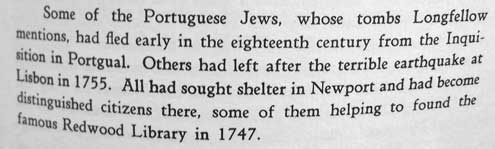
No seu bloco de notas, enquanto caminhava entre as campas, Longfellow foi escrevendo os nomes dos judeus portugueses ali sepultados. Professor de Românicas e Línguas Modernas em Harvard, o poeta ficou fascinado com a conjugação dos sobrenomes portugueses aos nomes próprios hebraicos que ele se habituara a encontrar na Bíblia.
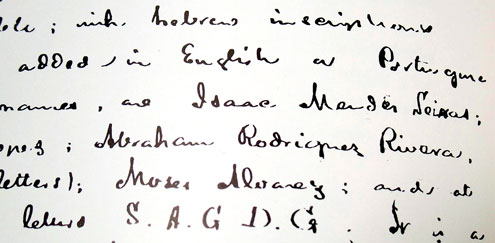
Escrevendo como um observador externo, Longfellow seria ainda indirectamente responsável por outra ligação dos judeus portugueses de Newport à poesia novecentista americana. Inspirada no poema de Henry Wadsworth Longfellow, Emma Lazarus — ela própria descendente de judeus portugueses — visita Newport em 1867 e, com apenas 18 anos de idade, escreve um poema sobre a Sinagoga Touro fazendo-o, desta vez, do lado de dentro da comunidade judaica sefardita dos Estados Unidos:
In the Jewish Synagogue at Newport
Here, where the noises of the busy town,
The ocean’s plunge and roar can enter not,
We stand and gaze around with fearful awe,
And muse upon the consecrated spot.
No signs of life are here: the very prayers,
Inscribed around are in a language dead,
The light of the “perpetual lamp” is spent
That an undying radiance was to shed.
What prayers were in this temple offered up,
Wrung from sad hearts that knew no joy on earth,
By these lone exiles of a thousand years,
From the fair sunrise land that gave them birth!
Now as we gaze, in this new world of light,
Upon this relic of the days of old,
The present vanishes, and tropic bloom
And Eastern towns and temples we behold.
Again we see the patriarch with his flocks,
The purple seas, the hot sky o’erhead,
The slaves of Egypt–omens, mysteries–
Dark fleeing hosts by flaming angels led.
A wondrous light upon a sky-kissed mount,
A man who reads Jehovah’s written law,
‘Midst blinding glory and effulgence rare,
Unto a people prone with reverent awe.
The pride of luxury’s barbaric pomp,
In the rich court of royal Solomon–
Alas! we wake: one scene alone remains
The exiles by the streams of Babylon.
Our softened voices send us back again
But mournful echoes through the empty hall;
Our footsteps have a strange, unnatural sound,
And with unwonted gentleness they fall.
The weary ones, the sad, the suffering,,
All found their comfort in the holy place,
And children’s gladness, and men’s gratitude
Took voice and mingled in the chant of praise.
The funeral and the marriage, now, alas!
We know not which is sadder to recall;
For youth and happiness have followed age,
And green grass lieth gently over all.
And still the shrine is holy yet,
With its lone floors where reverent feet once trod.
Take off your shoes as by the burning bush,
Before the mystery of death and God.
License
This work is published under a Creative Commons Attribution-NonCommercial-NoDerivs 2.5 License.
One thought on “Os judeus portugueses de Newport (I)”
Comments are closed.